

Product details
It is suitable for the use of pulley lagging of long-distance high-speed belt
conveying equipment, with the strongest anti-slip ability and service life, and
prolongs the equipment startup time by reducing the replacement frequency and
replacement time of the lagging.
Product Features:
1、Installation is more convenient and faster, and the replacement saves 50%
of labor;
2、It will not hurt the non-working surface of the conveyor belt, which is
more friendly to the conveyor belt;
3、Provide >40000 hours service life under normal working conditions;
4、It can be used in high belt speed, muddy,≥3000t/h conveying capacity and
other working conditions;
5、Safer hot vulcanization bonding process.
Product Parameters:
| Ceramic Tiles | |
| Al₂O₃ Content | 92%,95% |
| Volume Density | 3.65~4.5g/cm³ |
| Tensile Strength | 20 Mpa |
| Compressive Strength | 200 Mpa |
| Hardness(Mohs) | >9t |
| Water Absorption | <0.02 |
| Abrasion | <120 mm4 |
| Rubber | |
| Polymer | NR/SBR |
| Specific Gravity | 1.2+/-0.03 |
| Shore a (hardness) | 65+/-5 |
| Elongation at break | 400% |
| Tensile strength | 17 N/mm² |
| Abrasion Loss | <120 mm3 |
| Commodity | Thickness.mm | Width. mm | Length. mm |
| Normal Ceramic Lagging | 12/15/18/20 | 500 | Customized |
| Flame Retardant Ceramic Lagging | 12/15/18/20 | 500 | Customized |
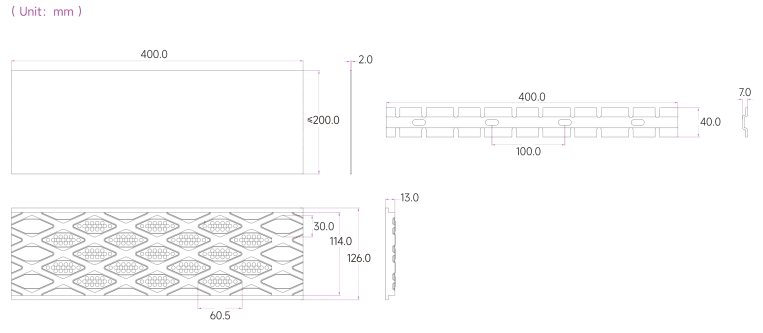
Product Size:
Application and selection guide
HCSRL-HD is the archived heavy duty ceramic slide-lag option for a compatible mechanical mounting system. Review the ceramic surface, retained section layout and available maintenance access against the conveyor’s pulley duty and existing shell arrangement.
Where this product fits
Explain the wear or slip issue behind the enquiry and why a mechanically retained surface is preferred. Distinguish the lagging replacement scope from any work needed on the pulley mounting system.
Information for a suitable proposal
Supply the retention and rail details, pulley face dimensions and belt information. Ask for the proposed heavy duty arrangement to be checked against the actual duty rather than the model name alone.
A slide-lag arrangement introduces a mechanical interface between the replaceable lagging and the pulley shell. Record the existing rail or retention details, segment layout and available access. A replacement strip must be compatible with the mounting system as well as suitable for the operating duty.
Installation and maintenance considerations
Inspect segment security, ceramic condition and the underlying retention system. Check damage to surrounding parts before renewing the wearing sections.
Provide photographs of the end retention and the areas showing wear. Discuss how worn components are removed and secured during replacement, and agree inspection access with the maintenance team. Damage to a rail or fixing should be assessed before new lagging is installed; a sound wearing surface cannot make up for an insecure attachment.
For related options, explore bonded and mechanically retained lagging or discuss the application with JuMing.